Marketing News
BSW is Gathering Pace

A full list of local events happening in butchers, farmshops, pubs and restaurants can be found by clicking here.
The Paul and Debbie tour is now finalised with the launch happening in London on Monday morning where they will award one of three finalist supermarkets a Banger Award, followed by a cook off from the regional butcher finalists. The tour will then travel to Cambridge, Southampton, Bristol, Birmingham, Nottingham, Manchester and Yorkshire finishing up in Newcastle on Friday morning. Other regional activity in the pipeline is sausage sandwich drops at regional radio stations, to be delivered by some of the LIPs team.
National events include:
- Market Kitchen, TV foodie show will be featuring Paul and Debbie cooking sausages on 5th November
- Countdown TV programme will feature a Porktrait of their set (image of their set produced using sausages and mash) on the 4 Nov show airing at 3.25pm on Channel 4
- Features on Jonathon Ross and Loose Women still tbc
Exeter Roadshow Results
An increase in attendees from last year saw a good result at the latest regional roadshow at Exeter this week, with 30 butchers entering 160 products. The overall winner this time being a Young Sausage Maker with his Pork, Honey and Mustard sausage. To be in with a chance of an award, the next event is 11 November at Harrogate, Great Yorkshire Showground. Go to www.porkforbutchers.co.uk
Pork Purchases Soaring
Consumer purchases of bacon are soaring and fresh pork and sausages are in hot pursuit according to new figures produced for BPEX. The figures show bacon purchases up 7.9 per cent, fresh pork up 5.3 per cent and sausages are showing a 2 per cent rise. BPEX head of Marketing Chris Lamb said: “This continues the trend of people looking for high quality, value for money pork. “This growth for both pork and for poultry comes at a time when beef and lamb are under pressure and are losing volume – even such staples as beef mince. “The figures also show, over the same period, twice as many households bought bacon than fresh chicken breasts while one and a half times more bought sausages. The figures are the latest from TNS and covers the four-week period ending on October 4, compared with the same period last year.
Knowledge Transfer
Tip of the week: NVZ calculations
Two Excel calculators to help BPEX levy payers work out their statutory calculations required by the NVZ regulations are now available on the BPEX website. Click here to access. There is one for continuous throughput systems and one for batch systems, the batch one having a significantly different approach to working out throughput. If you have any queries regarding either of the calculators contact Charles Baines of BPEX [email protected].
Three new Action for Productivity factsheets have just been printed, have you got yours yet? The new sheets focus on improving key performance indicators and reducing costs of production. They include target figures for you to benchmark against and aim for if you are not currently achieving that level of production. Copies of the sheets can be obtained in hard copy from BPEX and are available to download from the website: by clicking here.
Back to Top
Animal Bytes
The October edition of Animal Bytes is now available to view here: www.animalbytes.org. Papers include ‘Rearing environment is a key factor in determining pig gutmicrobiota’ and ‘Genotype has the greatest influence on pig performance whereas improvements due to vaccination against PCV2 is dependent on herd health status’.
Back to Top
Anaerobic Digestion Course
WRAP will be running a two day course for potential developers, managers, engineers etc on 20th – 21st October in Ludlow. Delegates will learn about planning, technology selection, funding and contract development, the anaerobic digestion process, quality control and standards, PAS 110 and the AD quality Protocol and biogas / digestate utilisation. The course will feature small group exercises as well as a site visit to an anaerobic digestion facility. For more information and to register, click here.
Back to Top
National News:
Huge Food Investment Needed
According to an FAO discussion paper published last week, net investments of $83 billion a year must be made in agriculture in developing countries if there is to be enough food to feed 9.1 billion people in 2050. This would imply that agricultural investment thus needs to increase by about 50 percent.
Required investments include crops and livestock production as well as downstream support services such as cold chains, storage facilities, market facilities and first-stage processing.
The projected investment needs to 2050 include some $20 billion going to crops production and $13 billion going to livestock production, the paper said. Mechanisation would account for the single biggest investment area followed by expansion and improvement of irrigation.
A further $50 billion would be needed for downstream services to help achieve a global 70 percent expansion in agricultural production by 2050.
Most of this investment, in both primary agriculture and downstream services, will come from private investors, including farmers purchasing implements and machinery and businesses investing in processing facilities.
Back to Top
NADIS Latest – Milk Spot
Data collected over many years, including more recently by the BPHS, indicates that the incidence of milk spot liver – the result of migrating Ascaris worm larvae – increases in late summer and early autumn. This is largely due to an accelerated life cycle in warmer summer weather leading to more rapid egg embryonation producing a higher number of cycles in a given time, producing a build-up of infective eggs in the environment.
Pigs being slaughtered at the present time show more evidence of milk spot, which not only requires condemnation of the liver but will have had a limiting effect on growth of the pigs.
Now is a good time to review worming policy particularly for growing pigs and all producers would gain valuable information by belonging to the BPHS and obtaining regular reports on carcass pathology.
Back to Top
FAWC Report Published
The Farm Animal Welfare Council (FAWC) today publishes its Report on the Welfare of Farmed Animals in Great Britain: Past, Present and Future
FAWC Chairman Christopher Wathes said: “In this landmark Report, FAWC has examined the effectiveness of British policy on farm animal welfare since the Brambell Report in 1965 and sets out a strategy that will lead to improvements in welfare over the next 20 years.”
“Of course, policy and practice must seek to eliminate cruelty and unnecessary suffering and to cater for an animal’s needs. But in the future farmers must ensure that each and every animal has a life worth living, from the animal’s point of view. This emphasis on an animal’s quality of life means that positive as well as negative experiences must be counted. This will require new methods to assess animal welfare over the animal’s lifetime.”
“Eating meat and using animal products requires hard moral choices to be made. The main conditions that we believe to be necessary for ethical consumerism and improved farm animal welfare are:
- The Government to act as the guardian of farm animal welfare
- Standards for a good life to be defined by an independent body
- Minimum welfare standards to be defined by an animal’s quality of life
- Stockmen to be educated and trained to a high standard about animal welfare
- Welfare assessment to be valid, feasible and rigorous with independent audit
- The food supply chain to show due diligence with marketing claims verified
- Citizens to be educated about food and farming from childhood
- Animal products to be labelled according to welfare provenance to provide consumer choice.”
Back to Top
Single Payment Rise
The Rural Payments Agency (RPA) has announced the exchange rate for the 2009 Single Payment will be 90.93p per Euro. This is a significant increase on 79p for 2008 (69p for 2007) and is good news for outdoor pig producers because they should now receive at least £139 per hectare entitlement net of deductions. Where they claim as part of an arable rotation they may receive more than this because of historic top-ups.
Also, the RPA has confirmed the minimum total area for future claims will be 1 hectare, which may affect some indoor producers and smallholders who previously only claimed for a small paddock or such like.
Single Payment applicants are also reminded to complete their Soil Protection Review by 31 December 2009.
Back to Top
Peta Poster Panned
An animal rights charity poster was banned today after a watchdog found it could lead people to believe eating meat caused swine flu.
The People for Ethical Treatment of Animals (Peta) advert, posted on a billboard in Glasgow in June, featured the recurring words "E.coli, mad cow, swine flu, MRSA" underneath the statement "Meat Kills".
The words "swine flu" were more prominent than the other text and a statement at the bottom of the poster read: "Go Vegetarian PETA."
The Advertising Standards Authority (ASA) investigated the poster after a member of the public complained it misleadingly implied swine flu could be caught by eating meat and that it might cause undue fear about how the illness could be contracted.
The watchdog upheld the complaint and said the advert should not appear again in that form.
It found the poster was misleading and could cause undue fear and distress to some people.
Peta said it was not their intention to suggest eating meat caused swine flu and argued consumers would know this was not the case because of the extensive Government health education programme and media coverage of how the illness was spread.
Back to Top
International News:
US Production Up
Increased pork production drove higher estimates for total meat production for 2009, as calculated by the USDA in its monthly World Agricultural Supply and Demand Estimates (WASDE) report. Growing levels of pork production more than offset cuts in beef and turkey production.
The higher pork production figures are due mainly to higher third-quarter slaughter and higher weights, due to favourable summer weather. Export figures, which were lowered from last month’s report, were left unchanged in the October figures.
Back to Top
Call for Export Refunds
Copa-Cogeca called on the EU Commission in Brussels today to introduce refunds for EU pigmeat exports immediately, warning that that the current crisis in the pigmeat sector is unsustainable and many producers will go out of business if no action is taken.
The move comes after Copa-Cogeca’s working party for pigmeat met in Brussels this week to discuss the drastic situation prevailing on the pigmeat market. Mr Tavares, President of the working party warned “The pigmeat sector is undergoing a crisis for the third consecutive year and perspectives for 2010 are not any better. If nothing is done immediately, millions of pigmeat producers will go out of business”.
The sharp drop of 15% in EU exports compared to 2008 combined with the fall in prices poses serious problems for pigmeat producers. Furthermore, pigmeat producers already have to invest huge amounts of money in order to meet new EU requirements for sow stalls by the deadline of 2013.
Concluding, Mr Tavares insisted “The EU Commission must not wait any longer and must introduce refunds for EU pigmeat exports immediately, otherwise more pigmeat producers will go bankrupt. The Free Trade Agreement with South Korea which was signed today by both sides will nevertheless help support the domestic market significantly as the EU exports a lot of pigmeat to the South Korean market”.
France, backed by many other member states, also urged the Commission at EU Farm Ministers last meeting in September to introduce export refunds for pigmeat, but the Commission has so far refused to act.
Back to Top
Norwegian H1N1
A pig herd in the Norwegian county of Nord-Troendelag has been found infected with H1N1 and has now been quarantined.
The Norwegian Food Inspectorate is now carrying out testing a number of pig breeding farms.
“What has happened is that the animals have received the infection through contact with a human who has been carrying the disease. We take this very seriously, since we have never before encountered pigs with swine flu in Norway, said Kristina Landsverk, director of the Norwegian Food Inspectorate.
Employees who suspect they may be carrying the virus have been told to stay away from the barn.
Back to Top
Demand for US Pork
USMEF said strong demand for U.S. pork in Japan and Mexico was offset by limited market access in China and Russia, where U.S. pork exports have declined by 70 percent and 40 percent, respectively, in the January-August period.
Nonetheless, increases in pork exports through the first eight months of 2009 to Australia, the Caribbean, Taiwan and the Philippines were bright spots.
Back to Top
Hamming It Up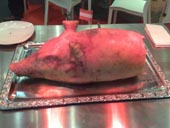
This intriguing shot of a carvery ham moulded into the shape of a suckling pig was spotted on an Austrian stand by BPEX head of Marketing while visiting the huge show Anuga. Chris was fascinated by it but didn’t think it likely that it would catch on here.
Back to Top
|